Discover
One date in. Seven dates out.
The J method spaces reviews at widening intervals. Here is what that looks like on a real calendar.
The intervals
A class learned on Monday 7 September
These are not illustrations. It is the calculation, applied to one date.
- J1 — Tuesday 8 September
- J3 — Thursday 10 September
- J7 — Monday 14 September
- J14 — Monday 21 September
- J30 — Wednesday 7 October
- J60 — Friday 6 November
- J90 — Sunday 6 December
An exam you enter truncates the series: nothing is laid down after it.
Falling behind
Ten days away is not twenty reviews
A missed review is not a debt to repay line by line. This is where the app differs most from a plain calendar.
It groups by course and offers only the most advanced one of each. Doing the J14 makes the missed J7 pointless.
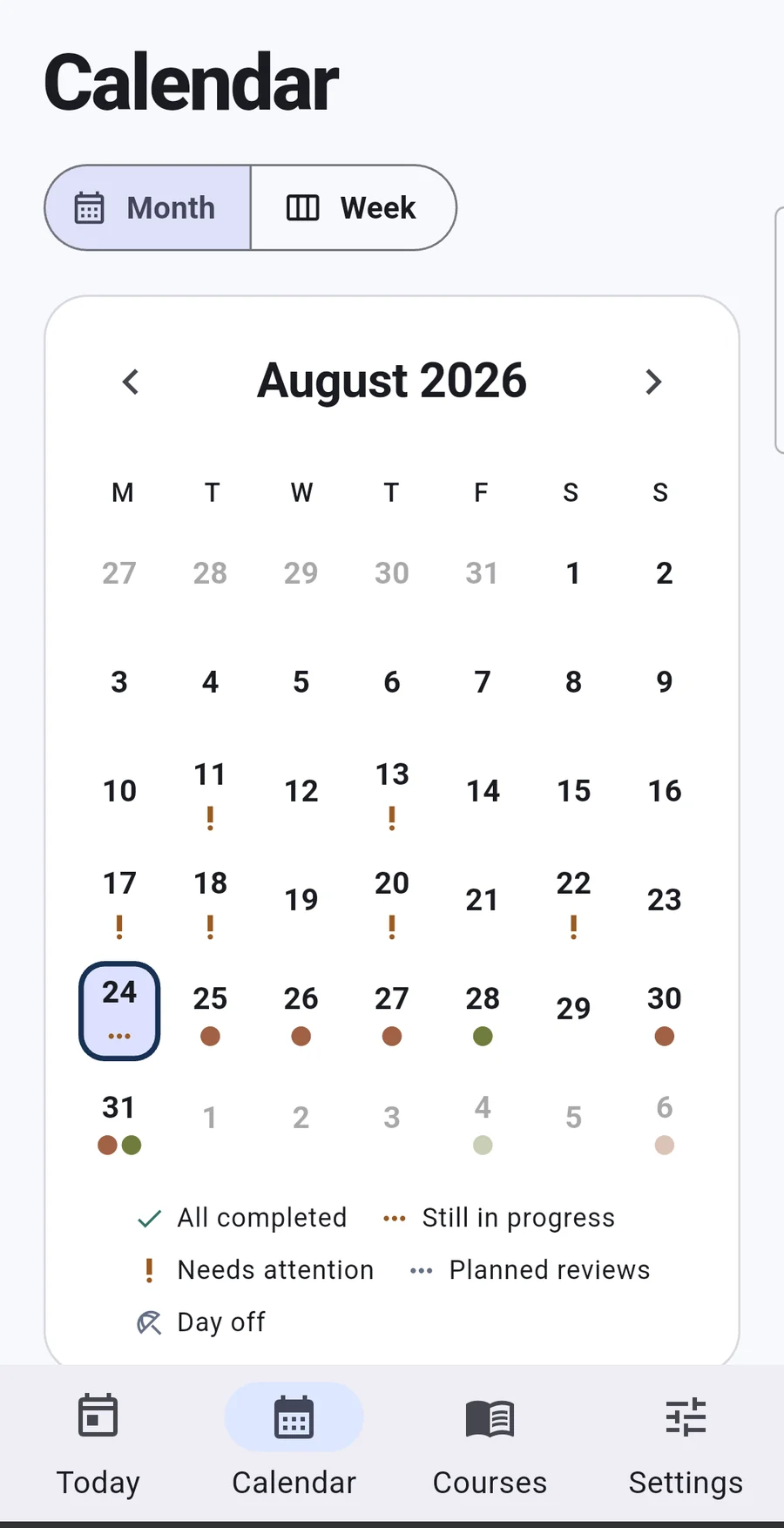
Twenty-three overdue across eight courses is eight things to do.
What it is
A planner, not a revision tool
Anki, RemNote and Quizlet host your content and quiz you on it. SuisTesJ does not do that, and will not try.
It records that a course was learned on a given date, and tells you which days to open it again — handout, handwritten notes, textbook, or an Anki deck.
So they are not competitors. The calendar and the content are two problems; this one solves only the first, completely.
In detail
The rhythm is visible, and editable
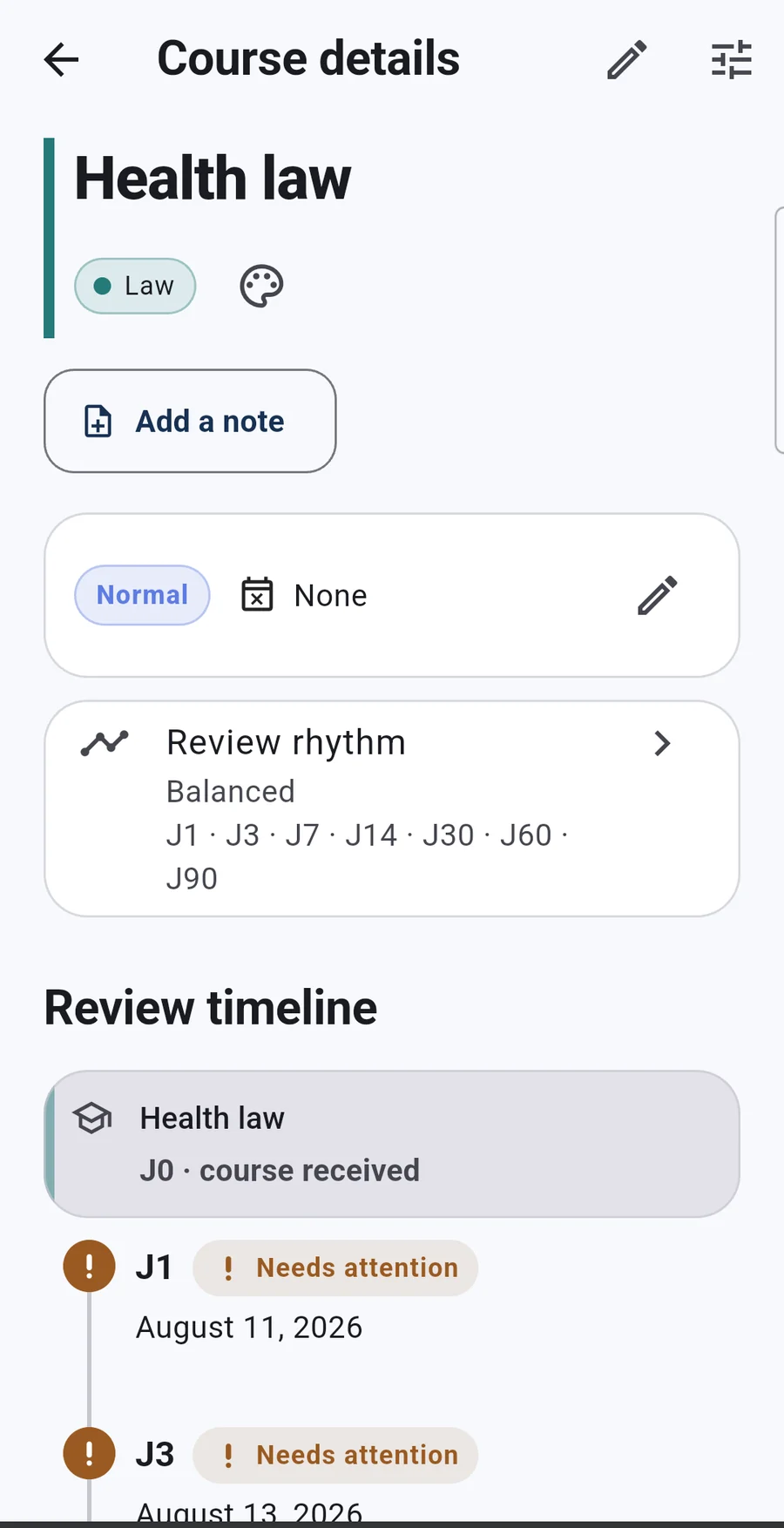
Each course shows its rhythm and the thread of its reviews: what is done, what is coming, on which date.
The default rhythm is balanced. You can define others if this one does not suit you.
Limits
What it does not do
- No course material: no editor, no attachment, no import.
- It does not quiz you and marks nothing.
- It does not score your performance or adapt the scale to your answers.
- It moves no review without telling you.
Spacing reviews and testing yourself rather than rereading are two well-supported techniques — see Cepeda et al. (2006), Roediger & Karpicke (2006), Dunlosky et al. (2013). That research describes the method, not this app. For the forgetting curve, the full dated example and common questions: the J method guide.